
Certainly an Energy Resource
Digital Trends: FUGITIVE GAS
Fugitive Emissions represent one of the main causative agents of global warming in recent years, due to this, governments have committed to reduce their emissions, with the main objective of reducing the venting and burning of gases in oil wells , oil facilities, gas processing plants and gas pipelines. However, this situation lacks a clear and precise strategy to reduce the levels of environmental pollution.
Methane (CH4) is a powerful greenhouse gas (GHG), its useful life in the atmosphere is much shorter than that of Carbon Dioxide (CO2), however, due to its chemical composition: one carbon molecule times four hydrogen molecules, traps more radiation from sunlight and scatters it toward the ground; consequently the average temperature of the planet increases causing global warming. The impact of methane on climate change is 20 times greater than that of Carbon Dioxide over a 100-year period and about 86 times greater over a 20-year period.
The Enviromental Protection Agency (EPA) National Greenhouse Gas Inventory estimates that in 2012, Methane contributed approximately 10% of gross greenhouse gas (GHG) emissions on a CO2 equivalent basis from anthropogenic sources. from the USA. According to the "Science" study that analyzed Methane emissions, approximately 2.3% of the natural gas produced in the US escapes directly into the atmosphere due to leaking equipment or intentional discharges (permissible discharges). Methane Gas leaks for the year 2019 are 2,564.73 Million Cubic Feet Day, which represents around US $ 4.5 million dollars per day lost in this element. The establishment of controls for the improvement of production processes, will allow to promote concrete measures in the reduction of fugitive emissions in the facilities.
Gas flaring associated with oil production is often permitted in the initial phase of well exploitation; Usable gas volumes can be counted for which an associated infrastructure such as collection lines, processing plants and compressors is required; The ideal is to create the conditions to optimize or plan the construction of operational facilities in the event that these do not exist.
If Rich Gas is collected and sent to processing plants to extract Natural Gas Liquids (based on gas richness - heavier hydrocarbons - GPM [1-4], number of gallons of liquid per 1000 ft3 of gas natural), then fractionate it and finally transport it for industrial use in the electrical, mining, petrochemical, oil and domestic sectors, we would then be helping to minimize the impacts on the environment, capturing fugitive gas and reducing the emission of Methane gas as a potential pollutant , and at the same time we would reduce the enormous waste of this energy source.
The investigations started in 2019 for the GPOG Project - Green Planet Oil and Gas (currently under development) by TLBS Corporation, suggest that the reduction of "GHG" emissions is technologically and economically possible, through the implementation of a system of integrated business management such as ERP software: "Essential ITS", which allows to obtain fast, agile and flexible results from economic technical feasibility studies.
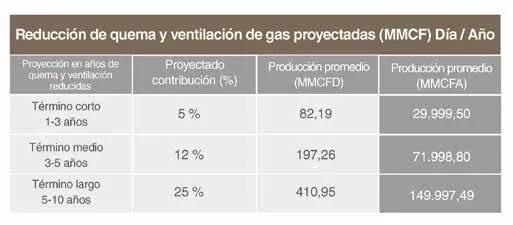
The project contemplates making the detection, measurement, concentration, quantification, sealing, capture, recovery, transformation and monetization of the recovered gas technologically possible, by controlling the burning, venting of natural gas and methane gas leakage. It will be addressed with pilot testing, integration and implementation with business, industrial and government systems. The short-term contribution will be 5%, medium-term 12%, and long-term 25%, in a period of 10 years projected in table 1
The main objective is to offer our clients the most advanced technology for leak detection, which allows to quantify the rate of fugitive gas emission in facilities (Measurement and Concentration); mitigate leakage, venting and burning and at the same time reduce high risks of fires and explosions in Oil & Gas facilities; through the implementation of emerging technologies such as Artificial Intelligence (AI), the Internet of Things (IoT), Cloud Data Management Software (USB WIRELEES), Emerging Technology of Small Unmanned Aerial Systems (SUAS) with high-end devices capable of delivering optical gas imaging (OGI) sampling for detection, and infrared (IR) technology to detect hot spots through (INTELLIRED) technology.
Additionally, the latest generation equipment for gas chromatographic analysis is a fundamental part of the asset conglomerate for the Gas Technology Laboratory, which converges in the portfolio of tools of the GPOG project. 2020 - 2030.
Since 2019, a team of specialist engineers develop skills through specialized training to obtain certification in the use of emerging technologies such as training programs for drone pilots, industrial robotics for facilities inspection and maintenance management software (CMMS), for the effective management of business assets , among which the selection of high-end tools stands out, where the integration capacity converges to the software environment to integrate the SGE within the GPOG 2020-2030 project: IBM Maximo Asset Management, FRACTTAL A product of Microsoft’s portfolio, E-Maint, a product of FLUKE, stands out as the most versatile and appropriate CMMS tools to integrate this project and process data capture and quality indicators.
The study variables integrated in a single system allow us to offer our clients a powerful, precise and complete solution that aims to reduce high costs and risks in Oil & Gas facilities.