
Green Planet Oil & Gas
Digital Trends: MONETIZATION OF NATURAL GAS
TLBS Corporation as an engineering company and general contractor, has integrated the environmental trend and sustainable development since 2019 with the impulse of the project called “Green Planet Oil & Gas” (GPOG). This project consists of the creation of service lines for the oil industry that help prevent environmental accidents and preserve the environmental balance, and includes three (3) areas of development: Reduction and use of venting / burning gases, Treatment and reuse of produced water from hydraulic fracturing and Artificial Intelligence for asset and facility maintenance management. This project has a very significant contribution of national interest since it contributes to reducing Emissions, with the quantification and reduction of the burning and venting of greenhouse gases . For this, it created its own Business Management System (SGE) controlled through software called "Essential-ITS", which offers comprehensive and technological solutions that allow processing of operational data extracted in the field for monitoring, development and control. through computer models managed from mobile devices through the App, and real-time monitoring (remotely) to achieve global positioning.
As a second convergent technological tool, the project uses software: (CMMS) Computerized Maintenance Management System, to control gas leaks in industrial plants. These tools will allow the integration of emerging technologies such as Artificial Intelligence (AI), the Internet of Things (IoT), industrial robotics and unmanned aerial vehicles (drones). Additionally, nanotechnology and biotechnology converge in a single system that can produce the results of inspection and sanitation of facilities. The information captured from the operational activity will allow the evaluation of facilities, processes and equipment that are related to the hydrocarbon production activity and its consequences. Next, preventive and corrective action plans are created in response to the environmental impact generated by said activities, in order to quantify and reduce greenhouse gases Carbon Dioxide (CO2) and Methane Gas (CH4), and determine the technical feasibility - economic for the adaptation of infrastructure and facilities that allow the use of natural gas according to the operational, environmental and geographical conditions that apply. That is, to implement a Business Management System (SGE) integrated to the processes that will allow a better management, use and exploitation of natural gas as a resource, this being the main source of green energy of national interest.
The investigations started for the project under development since 2019, have the sole purpose of controlling through an integral management system such as: Essential ITS, the burning and venting of natural gas and the leakage of methane gas. The average gas flaring in the US for 2019 was approximately 600,000 million cubic feet, that is, 1,643.83 million cubic feet per day, according to World Energy Trade, and 4,920 million tons of CO2 (MtCO2) were generated by emissions of Carbon Dioxide (CO2), where Oil contributed with 43% (2,115.6 MtCO2), Gas with 34% (1,672.8 MtCO2) and Carbon with 23% (1,131.6 MtCO2).
The first objective is to achieve results and methodology obtained from best practices in applied engineering sciences that will allow the identification of the type of gas to be flared or vented from its capture, data processing in the field and classification based on its composition and physical-chemical analysis [Heavy components - rich gas and light components - dry gas]. Figure 1 shows the value chain of gas for analysis, and by-products from production, processing, transportation, distribution and marketing for onshore and offshore projects at oil facilities.
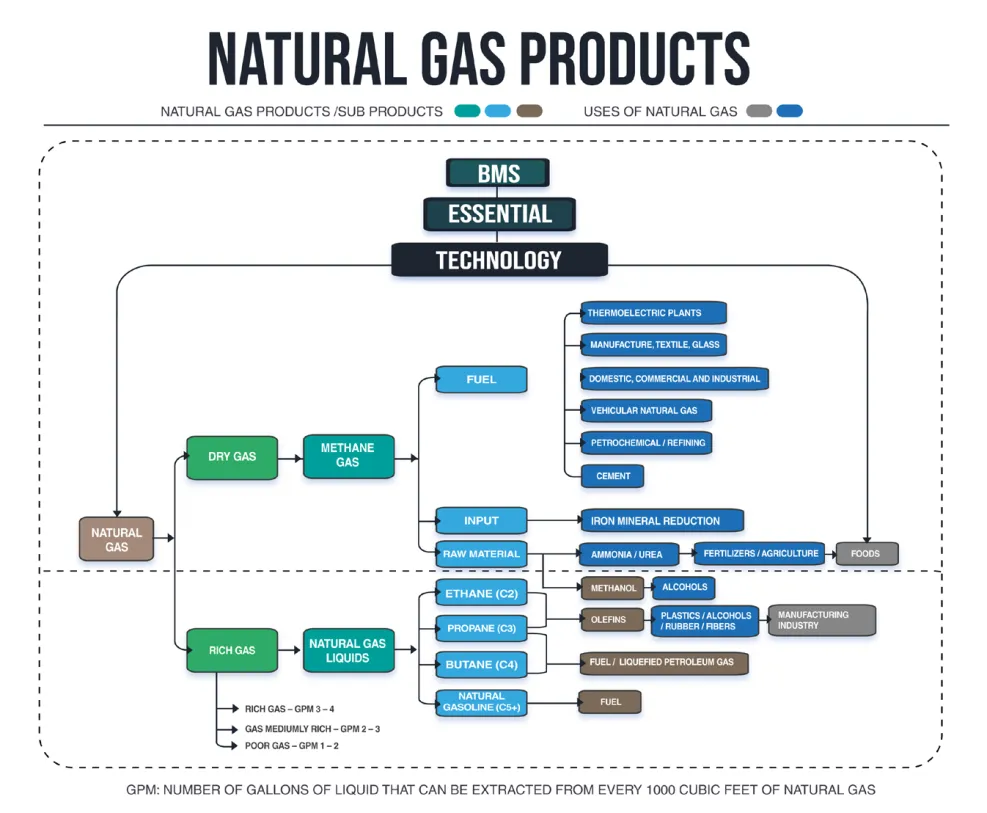
The second objective forms the basis of economic engineering aimed at checking the chemical composition and energy power of the study gas for its monetization. That is to say, to determine and define the commercial value based on the physicochemical and energy performance of the natural gas sub-products, such as: Ethane, Propane, Butane, Pentane, Natural Gasoline, Naphtha and Residual Gas classified as the main raw material of inputs for other processes that have a high commercial value to monetize through the following sectors: Petrochemicals, Thermoelectric, Manufacturing, Domestic, Commercial, Cement and Metallurgical, Industrial and Vehicle.
Burning and Venting Gas
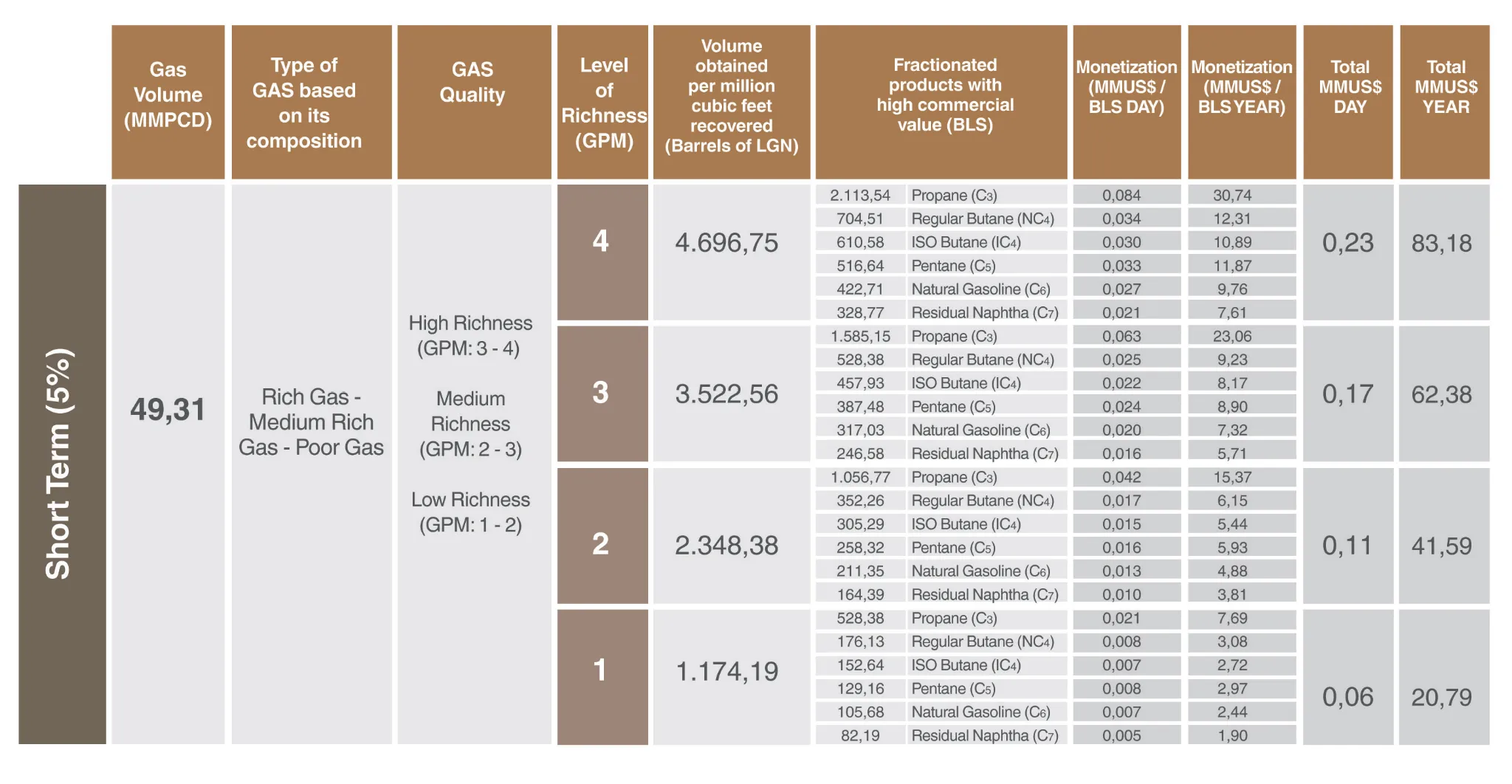
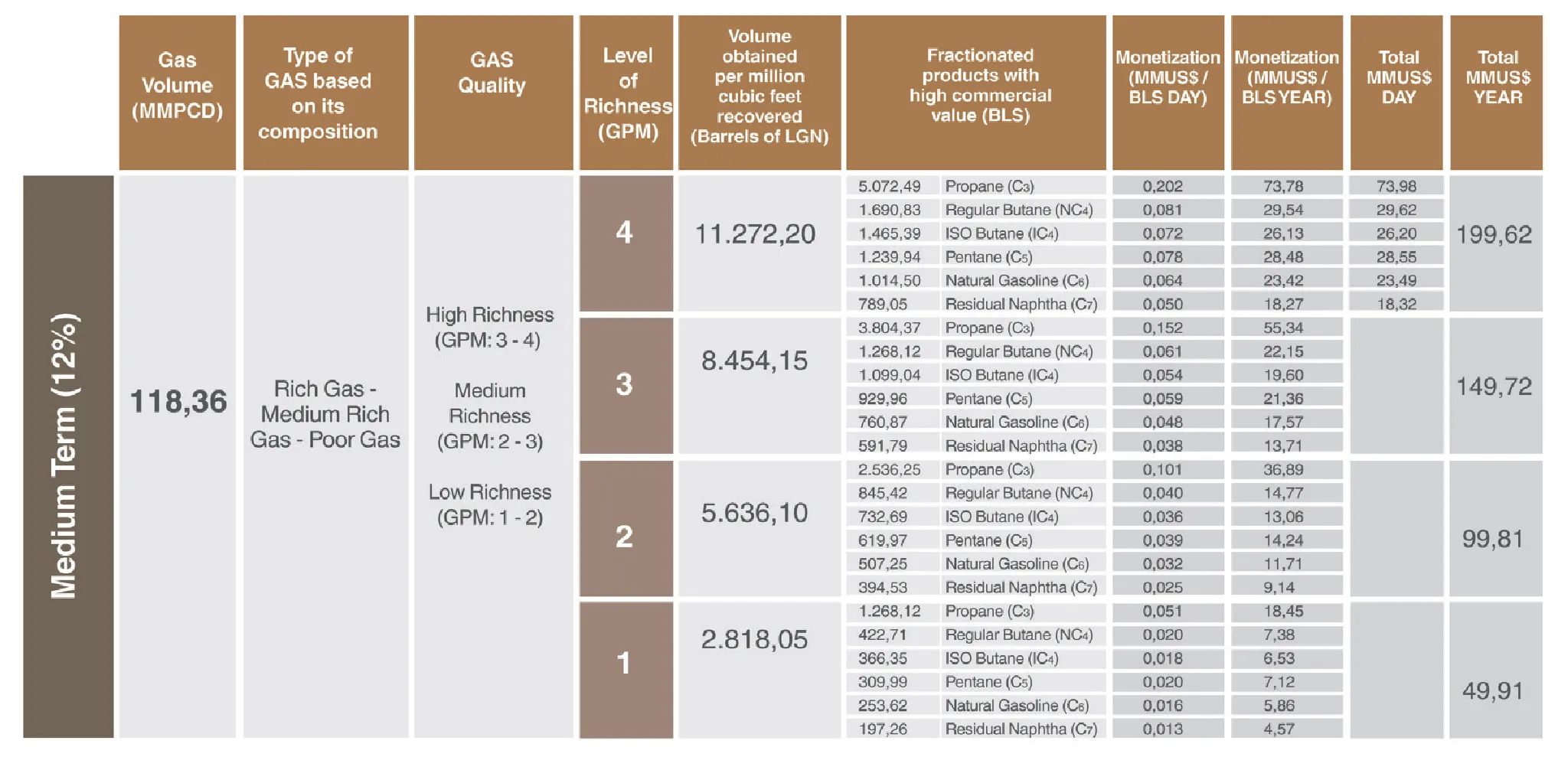
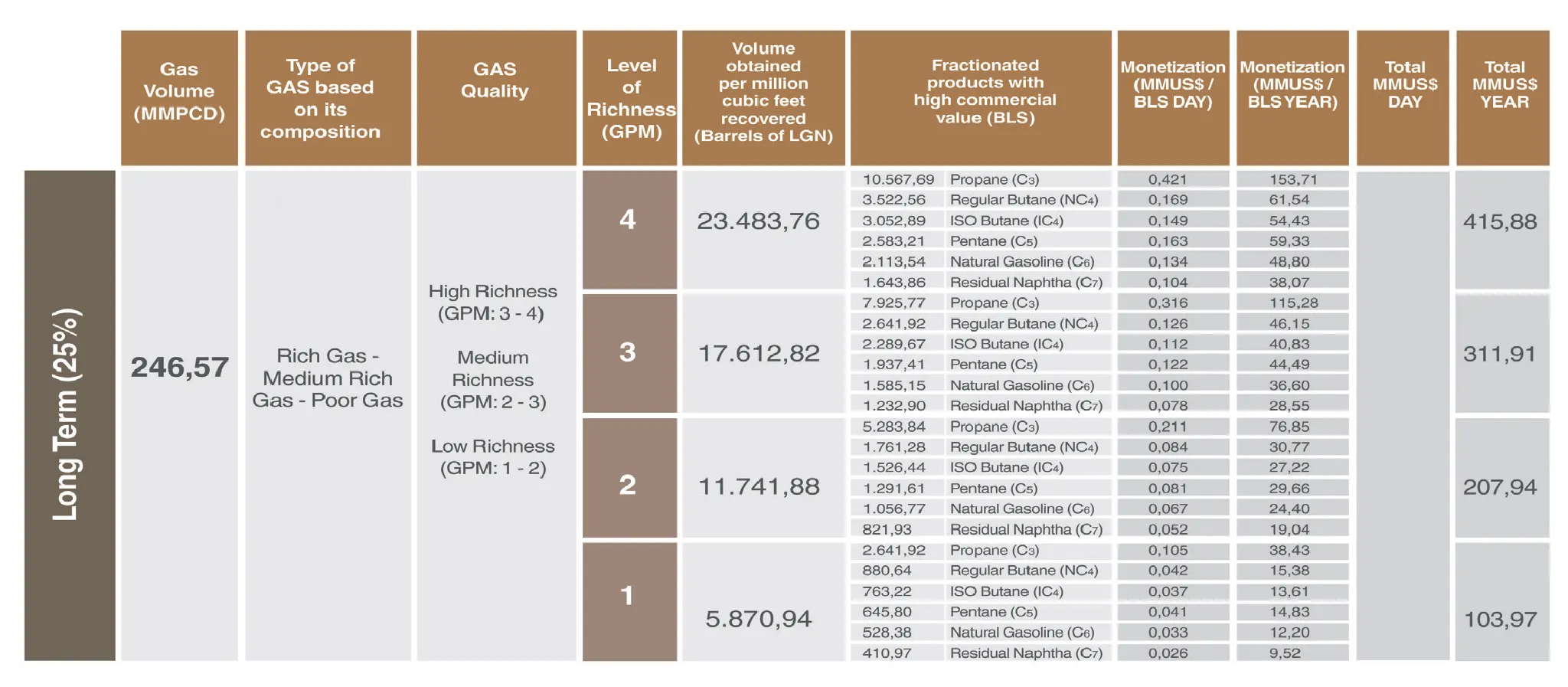
The project will be approached with pilot tests and implementation with a short-term (5%), medium-term (12%), and long-term (25%) contribution in a period of 10 years projected in table 1.
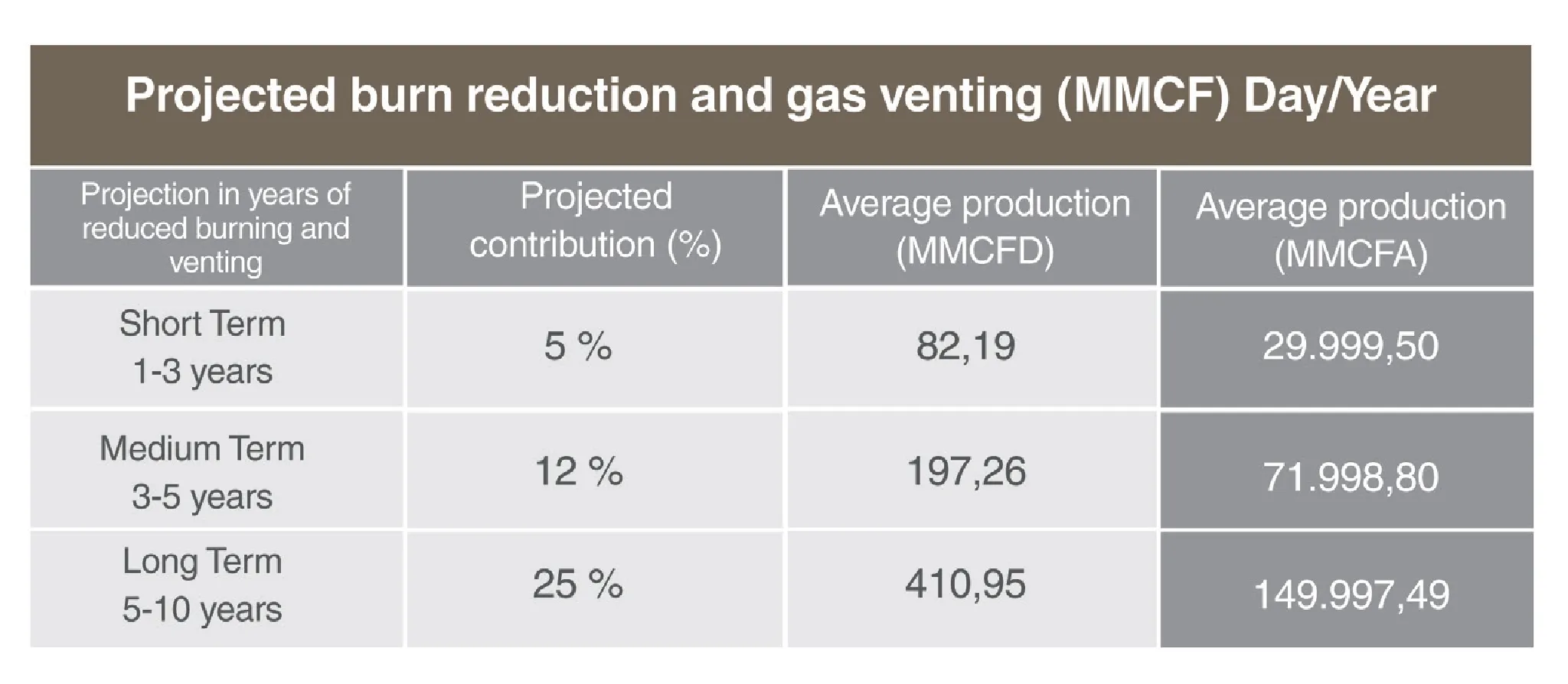
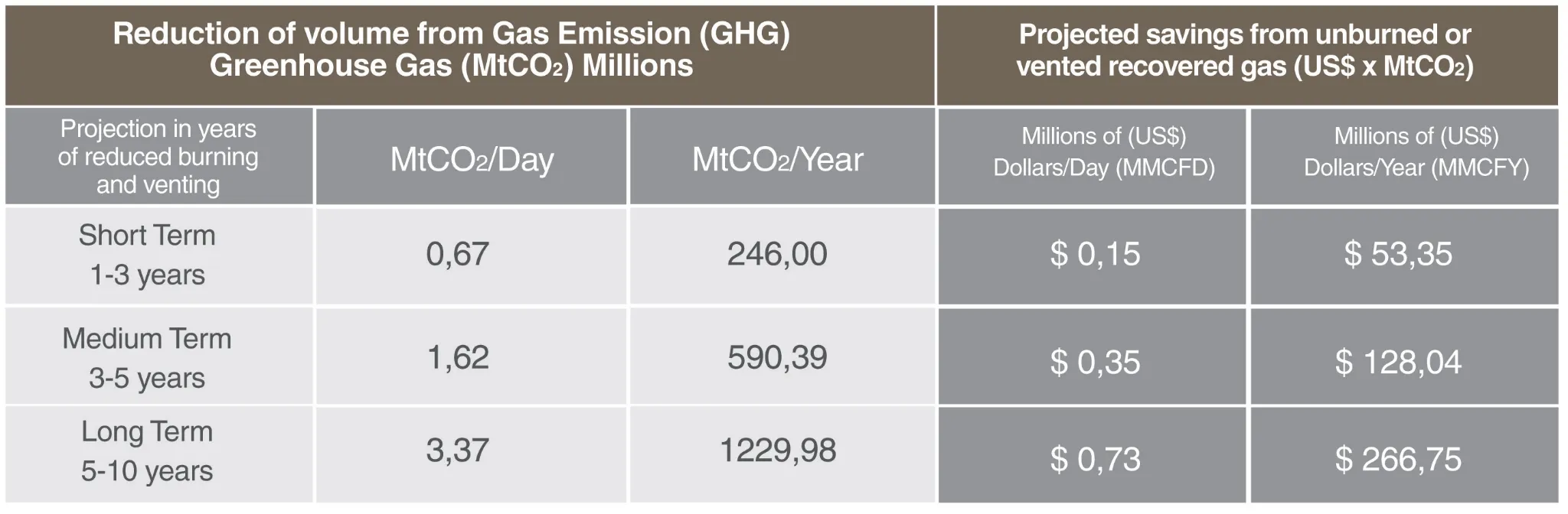
The expected result of this service line of the project is to achieve a recovery between (5% - 25%) of the burning and venting of gas in oil facilities, which translates to between 82.2 - 411.0 million cubic feet of gas per day that would stop burning and venting to the environment. For every million cubic feet of gas recovered per day, we help reduce the emission of 0.0082 million tons of (CO2) per day, which in terms of (5% - 25%) of gas to be recovered, would represent between 0.67 - 3.37 million tons of CO2 (MtCO2) per day and that per year would represent 246.0 - 1,229.98 million tons of CO2 (MtCO2), which cease to impact the environment as a greenhouse gas “GHG”. In the same way, it will reduce environmental penalties for companies in the Oil & Gas sector. Each million cubic feet day recovered has an average value that per year in absolute terms (5 - 25%) would represent monetizing between US $ 53.35 - US $ 266.75 million dollars. See table 2.
Natural Gas Liquids
The production of Natural Gas Liquids (NGL) of USA for 2019 according to the U.S. Energy Information Administration (EIA) was 1,756,753 thousand barrels (22) that is to say 4,813 thousand barrels per day, which represented an approximate income for 2019 of US$ 70,000 Million Dollars. Through this project, it will be possible to quantify up to 60% of the recovered gas that is flared and vented between 49.32- 256.57 Million Cubic Feet of Gas per day and that has the characteristics and composition of rich, medium-rich and poor gas, which through extraction and fractionation infrastructure would be obtained for a gas with a GPM of 3 gallons of liquid per 1000 cubic feet of natural gas on average, from Natural Gas in the order of 3,522. 56 - 17,612.82 Barrels per day of NGL, would generate products and sub-products of high commercial and export value for an amount of US$ 0.17 - 0.85 Million Dollars per day, which would generate an average income for the energy sector in the USA of between US$ 62.38 - 311.91 Million Dollars per year.
The intention is to redirect and store a large part of the gas recovered to reduce the emission of gases into the atmosphere, for a better use of the resource. Its controlled rational exploitation, in spite of avoiding high contamination, which impacts the planet’s climate change, is processed to convert it into a source of economic income for the main operating companies, from the extraction of liquids or products derived from recovered natural gas. The operational essence of the project starts from the inspections in industrial facilities, offering engineering based on the high standard of regulations and the control from technological solutions with short, medium- and long-term projection projected in Table 3 -5.
Fugitive Gas – Methane
Estimates and calculation applied to the project according to the study by Science (latercera/pulse-trader/news/leaking-threatening-image-of-natural-gas), which analyzed methane emissions, approximately 2.3% of natural gas produced in the United States escapes directly into the atmosphere due in part to leaking equipment or intentional discharges.
This is a concrete response to the problem of gas emissions into the atmosphere from leaks detected in oil facilities in natural gas extraction and processing areas. The aim is to reduce gas emissions (into the atmosphere) and reduce the high risk of explosions, applying the best handling and processing practices for greater use of the resource.
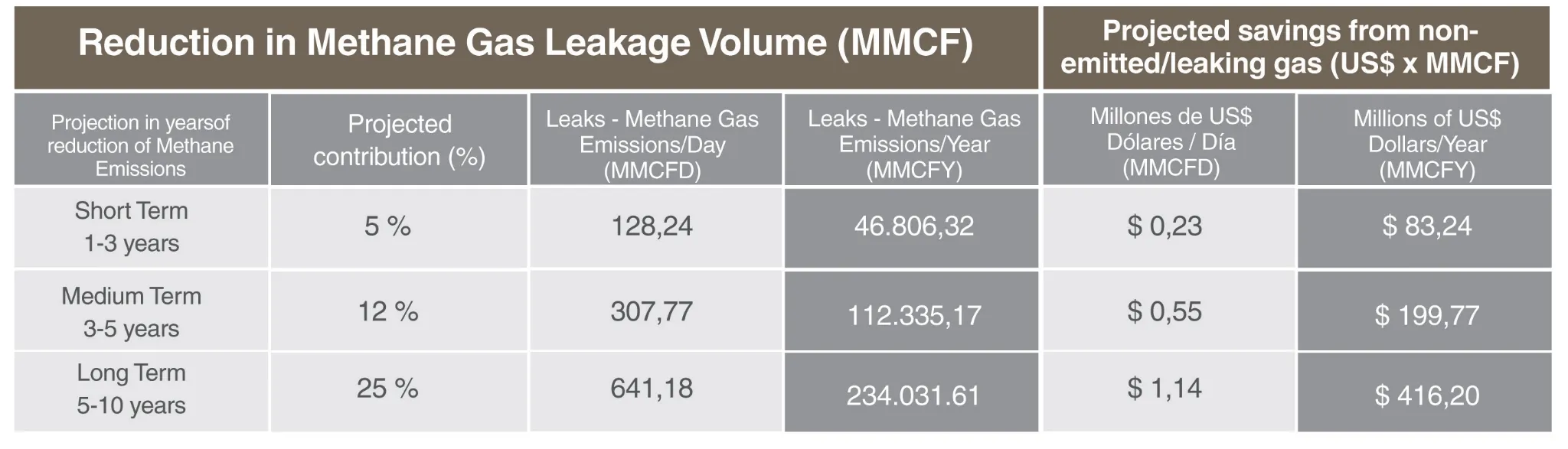
Its rational exploitation controlled by artificial technology for maintenance management, also seeks to reduce insurance risk premiums and payment of taxes or penalties by governments, as a result of pollution by greenhouse gas emissions; addressed from the beginning of the pilot tests and inspections in industrial facilities with short, medium- and long-term projections projected in table 6.
a) Short Term: 1-3 years:
Estimated Contribution is about (5%), which represents a volume of reduction of leaks and methane gas emissions: (128.24 Million cubic feet/Day). This constitutes a 46,806.32 Million cubic feet/year). Monetization is projected at an average of (0.23) Million ($) Dollars/Day. (83.24) Millions of ($) Dollars/Year.
b) Medium Term: 3-5 years:
The estimated contribution is about (12%), which represents a reduction volumen of leaks and methane gas emissions: (307.77 Million cubic feet/Day). This constitutes 112,335.17 Million cubic feet/year). Monetization is projected at an average of (0.55) Million ($) Dollars/Day. (199.77) Millions of ($) Dollars/Year.
c) Long Term: 5-10 years:
The estimated contribution is about (25%), which represents a reduction volume of leaks and methane gas emissions: (641.18 Million cubic feet/Day). This constitutes 234,031.61 Million cubic feet/year). Monetization is projected at an average of (1.14) Million ($) Dollars/Day. (416.20) Millions of ($) Dollars/Year.
Natural gas is one of the cleanest sources of fossil energy; it emits 45% less CO2 than coal and 30% less than oil, making it the fossil fuel with the least adverse effects on the environment. Taking into account the above, we can indicate that the United States could increase its economy based on its energy potential by placing as a reference the exploitation and rational use of natural gas in the country’s productive sectors and at the same time be a concrete response to the problem of "GHG" emissions.